I was looking for my phone, as most teenagers find themselves doing. Except, I never lost my phone, so I was looking for who took it. And as I approached my autistic brother Lawrence’s room, the last place I hadn’t checked, I heard my own voice floating through the door. I frowned, opening the door, to find him rocking back and forth, bouncing around the room, and grinning with his face pressed to the phone. He was listening to a recording of me singing “Girl on Fire” by Alicia Keys.
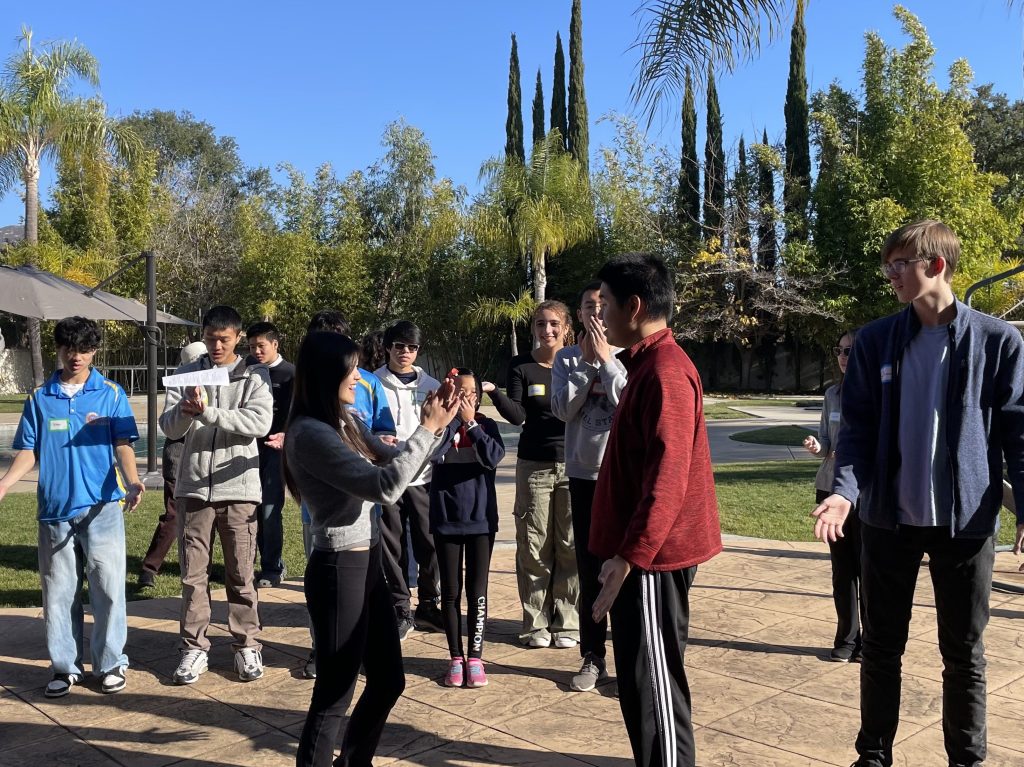
I never thought my background as a singer could influence my relationship with my brother. I’ve been a professional singer, actress, model, and voiceover artist since I was twelve and joined the SAG-AFTRA union when I was fourteen, but I’ve been singing since I was eight years old. Most of my performing is done at competitions or at a studio, so I don’t always have eyes on Lawrence when I’m singing. Now, I regularly teach him and other neurodiverse children how to sing and dance.
So what happened after I found him — my phone thief? I became his personal radio for the next few hours. He would chirp out the name of a song, I would pull up a karaoke track, and sing live for him while he danced around joyously. Lawrence was non-speaking for much of his early childhood, and thanks to speech therapy and my vocal exercises, he is now able to speak and articulate words, though he still struggles with comprehension and language in general. This created a large communication barrier between us, which made it difficult for me to connect with him as a child. But this was the first time I felt like we could understand each other completely.
I’ve experimented with different kinds of music; I wanted to figure out just what makes music so enjoyable among almost all autistic individuals I know. For days, I sat in his room and observed his choices, the way his body rocked according to the beat, and the certain segments of the song he repeatedly rewinded and listened to. Lawrence’s favorite songs are by Taylor Swift, older 90’s pop with upbeat tempos, and generally any song with interesting percussions. Most of the songs also have a very catchy chorus with a distinct melody repeating throughout the song. Listening to music and singing became a bonding experience for us.
In teaching autistic individuals (including Lawrence) how to sing, through my non-profit, Tutors4Stars-ACT, which aims to advocate and provide education/training to the neurodiverse community, I’ve started to realize both different and universal responses. One universal response I observed was body movements — rocking, swaying, arm-swinging — all usually aligned with the beat of the song. Also, most students of mine love up-beat songs; some like rap music, some like pop, and some like rock. Individual challenges come with individual complexities, given the large autism spectrum, and I have to personalize my approach for each student. Singing involves the connection of breath and voice, as well as your diaphragm, a key muscle in proper breath support. Many of my students struggle with mind-body connection, so this is the main difficulty — connecting breath (which needs to be controlled) with a continuous string of voice.
I created my own hypothesis as to why this happens. I am not a psychology expert, but according to the journal NeuroImage, the synchrony we see in all individuals when it comes to music can be monitored in brain activity. Most often, the right brain hemisphere is associated with interpretation of musical melody, while the left brain hemisphere is responsible for interpretation of speech. This is what I believed was the reason why Lawrence gravitated towards songs with simple lyrics but more-complex melodies, since he particularly struggles with speech and language-related activities. According to multiple studies, most autistic individuals have a preference for music over verbal material1 and overall, prefer more-predictable2 and upbeat music.3 Autistic individuals also showed more activity in dorsolateral prefrontal regions4 while showing decreased activity in the premotor and left anterior insula5 in response to happy, up-beat music. All of this seems to be in-line with my initial observations of all my autistic students.
According to Psychology Today, “Bronson Harry and colleagues identified distinct but overlapping cortical (auditory cortex and primary motor cortex) and subcortical brain networks (cerebellum and basal ganglia) that facilitate sensory-motor integration during rhythmic human behavior.” Harry writes in the study, “Simultaneous self-other integration and segregation can be viewed as a specific form of balancing internal (self) versus external (other) sources of information. Expertise in domains where rhythm is a key element may be characterized by the strategic modulation of this balance.” I interpreted this as a direct connection between music (sensory), where “rhythm is a key element,” and coordinated body movement (motor), which is synchronized with the music through this “self-other integration.” This synchronization and brain activity (measured by MRI) is similar for both autistic and neurotypical individuals.6
The fact that our brain activity, especially regarding sensory-motor overlap, is very similar in both neurotypical and autistic individuals emphasizes the potential bridge we can form between the neurotypical and neurodiverse communities through music. Without music, I (neurotypical) could not have connected so easily with my brother (autistic). Through body language and the songs we played, there was a way for us to communicate emotion and happiness; I could learn so much more about Lawrence than words could express. And through teaching other neurodiverse students music and dance, I’ve built trust and connection with them as well. I urge all neurotypical and neurodiverse individuals to utilize this great tool of music to unite and connect; in a world where there is too much stigma and misunderstanding, it is vital we do so.
- Barnes, Jaclyn A., et al. “Child-robot interaction in a musical dance game: An exploratory comparison study between typically developing children and children with autism.” International Journal of Human–Computer Interaction 37.3 (2021): 249-266. ↩︎
- Goris, Judith, et al. “The relation between preference for predictability and autistic traits.” Autism Research 13.7 (2020): 1144-1154. ↩︎
- Barnes, Jaclyn A., et al. 249-266 ↩︎
- Gebauer, Line, et al. “Intact brain processing of musical emotions in autism spectrum disorder, but more cognitive load and arousal in happy vs. sad music.” Frontiers in neuroscience 8 (2014): 192. ↩︎
- Caria, Andrea, Paola Venuti, and Simona De Falco. “Functional and dysfunctional brain circuits underlying emotional processing of music in autism spectrum disorders.” Cerebral Cortex 21.12 (2011): 2838-2849. ↩︎
- Caria, Andrea, Paola Venuti, and Simona De Falco. 2838-2849. ↩︎
 TUTORS4STARS ACT
Leave a comment